
Welcome! This guide assists navigating your recently purchased Nikon D5500’s features, offering in-depth reference manuals in PDF format for easy access.
Download the full manual, or utilize the Nikon Manual Viewer 2 app on your smartphone for convenient, on-the-go assistance with your camera.
What’s in the Box
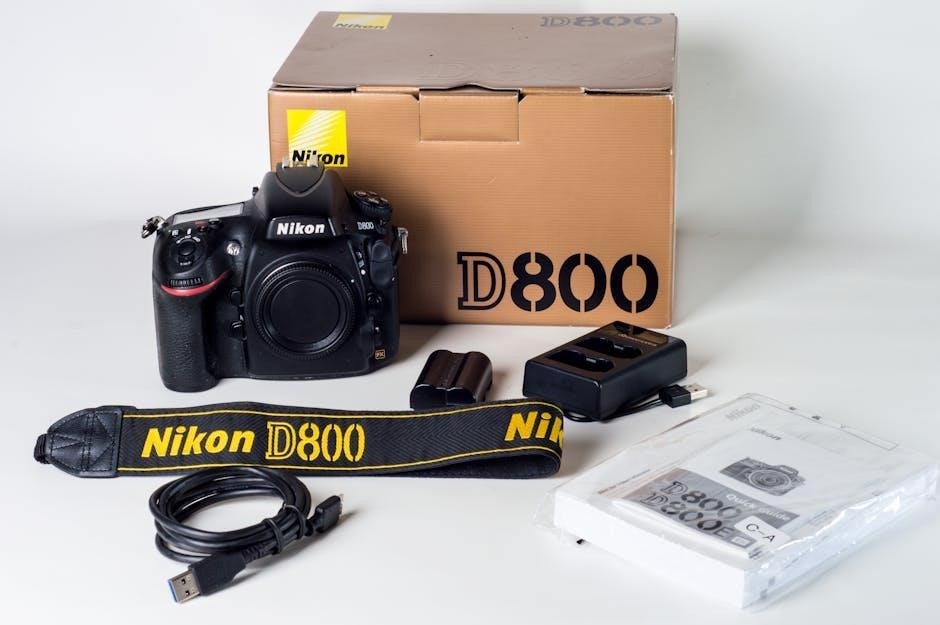
Upon unboxing your new Nikon D5500, you’ll find several essential components to get you started on your photographic journey. Included is the D5500 body itself, naturally, alongside the standard Nikon battery and charger, ensuring you’re powered up and ready to capture moments.
You’ll also receive a comfortable neck strap for secure carrying, and the necessary documentation – crucially, a quick start guide and a reference manual (often available as a PDF download). Don’t forget the USB cable for transferring images to your computer, and the body cap to protect the sensor when a lens isn’t attached.
Finally, you’ll find the Viewfinder Eyepiece, and important warranty information. Refer to your manual for a complete inventory and detailed explanations of each item.

D5500 Key Features Overview
The Nikon D5500 boasts a remarkable 24.2-megapixel DX-format CMOS sensor, delivering stunning image quality and detail. Its 3.2-inch vari-angle touchscreen LCD allows for flexible shooting from various angles, enhancing composition and ease of use. Wi-Fi connectivity enables seamless image transfer to smartphones and tablets for instant sharing.
This camera features a wide ISO range (100-25600), ensuring excellent performance in low-light conditions. The 39-point autofocus system guarantees sharp and accurate focusing, while Full HD 1080p video recording captures smooth, high-quality footage.
Consult your manual for detailed explanations of these features and how to optimize them. The PDF manual provides in-depth guidance on utilizing the D5500’s capabilities.

Getting Started with Your D5500
Begin your photographic journey! Refer to the comprehensive Nikon D5500 manual (available as a PDF) for setup, battery charging, and card formatting instructions.
Charging the Battery
Initial Charging is Crucial: Before first use, fully charge the EN-EL14a battery; Connect the battery to the EH-5b AC adapter, then plug the adapter into a standard wall outlet; The charging indicator on the adapter will illuminate red, signifying the charging process has begun.
Charging Time: A full charge typically takes approximately 2 hours. The indicator will turn off when charging is complete. You can continue to use the camera while the battery is charging, but this will significantly extend the overall charging time.
Important Notes: Only use the supplied Nikon battery and charger. Avoid exposing the battery to extreme temperatures or moisture. Refer to your D5500 manual (PDF version available online) for detailed safety precautions and troubleshooting tips regarding battery performance.
Inserting and Formatting the Memory Card
Card Compatibility: The Nikon D5500 supports SD, SDHC, and SDXC memory cards. Ensure the card’s write-protect switch is in the unlocked position before insertion. Locate the memory card slot on the camera’s side, and gently insert the card until it clicks into place.
Formatting is Essential: Before first use, or when transferring images to a computer, format the card within the camera. Navigate to the setup menu and select “Format memory card.” This ensures optimal compatibility and performance.
Caution: Formatting erases all data on the card! Always back up important images before formatting. Consult the full D5500 manual (available as a PDF download) for detailed instructions and troubleshooting regarding memory card issues.
Attaching and Removing Lenses
Lens Mounting: Align the lens mounting index (the dot or triangle) on the lens with the corresponding mark on the camera body. Gently push the lens in and rotate it clockwise until it clicks securely into place. Avoid forcing it; proper alignment is key.
Lens Release: To remove the lens, locate the lens release button on the camera body. Press and hold the button while gently rotating the lens counterclockwise. Lift the lens straight off.
Important Precautions: Always point the lens downwards when detaching to prevent dust from entering the camera body. Refer to the comprehensive D5500 manual (available as a PDF) for detailed diagrams and compatibility information regarding Nikon lenses.

Understanding the Camera Interface
Explore the D5500’s controls! The manual details the Mode Dial, menu navigation, and information display – essential for mastering your Nikon’s functionality.
The Mode Dial Explained
The Mode Dial, prominently located on the top right of your Nikon D5500, is your primary control for selecting shooting modes. Understanding each mode is crucial for capturing the images you envision.
Auto and Scene modes offer simplified operation for beginners, while P (Program Auto) provides some control over settings like ISO. S (Shutter Priority) lets you set the shutter speed, ideal for action shots, and A (Aperture Priority) controls depth of field. M (Manual) grants full creative control over both aperture and shutter speed.
Refer to your Nikon D5500 manual for detailed explanations of each mode and how they impact your photographs. The manual also covers the U1, U2, and FX modes, allowing for customized settings and shooting with the full sensor width.
Navigating the Menu System
The Menu System on your Nikon D5500 is accessed via the ‘Menu’ button on the rear panel. It’s organized into several tabs – Shooting Menu, Recording Menu, Setup Menu, and Retouch Menu – each containing numerous customizable settings.
Use the multi-selector and the rear dial to scroll through menus and adjust options. The Nikon D5500 manual provides a comprehensive breakdown of each setting, explaining its function and potential impact on your images. Don’t hesitate to consult it!
The Nikon Manual Viewer 2 app offers a digital version of the manual for convenient reference. Mastering the menu system unlocks the full potential of your camera, allowing for precise control and personalized shooting experiences.
Understanding the Information Display
The Information Display on the Nikon D5500 provides crucial shooting data. You’ll find it on both the rear LCD screen and in the optical viewfinder. Key information includes aperture, shutter speed, ISO, exposure compensation, focus mode, and battery level.
Pressing the ‘i’ button cycles through different information displays, customizing what’s visible; The Nikon D5500 manual details each displayed element, explaining its significance. Understanding this display is vital for controlling your camera settings.
Refer to your manual or the Nikon Manual Viewer 2 app for a complete explanation of all icons and indicators. Familiarizing yourself with the information display empowers you to make informed shooting decisions and achieve desired results.

Shooting Basics
Master the fundamentals! The Nikon D5500 manual guides you through focusing modes, aperture, shutter speed, and ISO settings for optimal image capture.
Focusing Modes and Techniques
Achieving sharp images with your Nikon D5500 relies on understanding its focusing capabilities. The manual details Single-point AF, ideal for stationary subjects, allowing precise focus point selection. Dynamic-area AF tracks moving subjects within a defined area, while 3D-tracking focuses on a subject and continues tracking it as it moves across the frame.
Explore Auto-area AF for automatic subject detection, though manual control offers greater precision. Learn about focus lock – separating focusing from shooting – and back-button focus for customized control. The manual also explains focus modes like AF-S (single servo), AF-C (continuous servo), and AF-A (automatic servo) to match your shooting scenario. Mastering these techniques, as outlined in the manual, will significantly improve your image quality.
Aperture, Shutter Speed, and ISO
Understanding the exposure triangle – aperture, shutter speed, and ISO – is crucial for photographic control. The Nikon D5500 manual explains how aperture (f-stop) controls depth of field, influencing how much of the image is in focus. Shutter speed determines exposure duration, impacting motion blur. Faster speeds freeze action, while slower speeds create motion blur.
ISO controls the camera’s sensitivity to light; higher ISOs are useful in low light but can introduce noise. The manual details how these settings interact, allowing you to achieve desired exposure and creative effects. Learn to balance these settings for optimal image quality, and explore semi-automatic modes like Aperture-priority and Shutter-priority for simplified control, as detailed within the comprehensive manual.
Shooting in Auto Mode
For beginners, the Nikon D5500’s Auto mode simplifies photography. The manual explains that in Auto mode, the camera automatically selects the optimal settings – aperture, shutter speed, ISO, and white balance – for the scene; This is ideal for quick snapshots and everyday shooting when you don’t want to worry about technical details.
However, the manual also advises understanding that Auto mode offers limited creative control. To move beyond automatic settings, explore Scene modes (portrait, landscape, etc.) which provide pre-configured settings for specific situations. The manual details how to access and utilize these modes effectively, offering a stepping stone towards mastering manual controls and achieving your desired photographic vision.

Advanced Shooting Techniques
Explore Picture Control settings, exposure compensation, and white balance—detailed in the manual—to refine images beyond automatic modes and unlock creative potential.
Using Picture Control Settings
Picture Control settings are a powerful tool for customizing the look of your images directly within the camera, eliminating the need for extensive post-processing. The Nikon D5500 offers several preset options, including Standard, Neutral, Vivid, Monochrome, Portrait, and Landscape.
Each Picture Control adjusts parameters like sharpness, contrast, brightness, and saturation to achieve a specific aesthetic. For example, Landscape enhances blues and greens for vibrant outdoor scenes, while Portrait softens skin tones for flattering results.
You can further refine these presets by accessing the Picture Control settings in the camera menu, allowing you to adjust individual parameters to create a truly personalized look. Experimenting with these settings is key to understanding how they affect your images and developing your own unique style. The manual provides detailed explanations of each parameter.
Working with Exposure Compensation
Exposure Compensation is crucial for achieving properly exposed images, especially in challenging lighting situations. When your camera’s meter is fooled by bright or dark scenes, Exposure Compensation allows you to override the automatic settings and brighten or darken the image.
The D5500’s Exposure Compensation scale typically ranges from -5 to +5 stops. Positive values brighten the image, useful for dark subjects against a bright background, while negative values darken it, ideal for bright subjects against a dark background.
Understanding how to use Exposure Compensation effectively will significantly improve your photography. Refer to your manual for detailed instructions on accessing and adjusting this setting. Practice using it in various scenarios to master its impact on your final images and achieve consistent results.
Understanding White Balance
White Balance (WB) ensures accurate color rendition in your photographs. Different light sources emit varying color temperatures, impacting how colors appear in your images. Incorrect WB can result in unwanted color casts – images appearing too blue, yellow, or green.
The Nikon D5500 offers several WB presets, including Auto, Daylight, Cloudy, Fluorescent, and Incandescent. ‘Auto’ attempts to determine the correct WB automatically, but manual selection often yields better results. Custom WB allows you to set a precise WB using a white or gray card.
Experiment with different WB settings to achieve the desired look. Your manual provides detailed guidance on each preset and custom WB setup. Mastering White Balance is key to capturing true-to-life colors and enhancing the overall quality of your photographs.
Troubleshooting Common Issues
Facing problems? Your manual offers solutions for focus issues, error messages, and battery concerns, ensuring a smooth shooting experience with your D5500.
Fixing Focus Problems
Is your Nikon D5500 struggling to achieve sharp focus? Consult your manual for detailed troubleshooting steps. A common issue involves a detached internal focusing screen, causing erratic behavior dependent on camera angle – a repair may be necessary.
Ensure your lens is securely attached and compatible. If using an adapter like the FT1 with a lens such as the Nikon 70-300 AF-P, verify compatibility; some combinations may not function correctly.
Experiment with different focusing modes (Single-servo AF, Continuous-servo AF) and focus areas. Clean the lens contacts and sensor. Refer to the manual’s section on autofocus settings for optimal performance and clarity.
Dealing with Error Messages
Encountering an error message on your Nikon D5500? Don’t panic! Your manual is the first resource. Error messages indicate specific issues, ranging from memory card problems to lens communication errors. Note the error code precisely.
Common solutions include reformatting the memory card, ensuring lens compatibility (especially with adapters like the FT1), and checking battery levels. If an error persists, consult the manual’s troubleshooting section for detailed explanations and recommended actions.
Online Nikon communities and forums (see Resources) can also provide assistance, as other users may have encountered and solved the same issue. Always prioritize the manual’s guidance first.
Battery Issues and Solutions
Experiencing short battery life or charging problems with your Nikon D5500? The manual details proper battery handling. Always use the supplied Nikon charger; third-party chargers may damage the battery. Ensure the battery contacts are clean and free of debris.
If the camera won’t charge, try a different outlet or USB cable (if applicable). Cold temperatures significantly reduce battery performance; keep the battery warm. A fully charged battery should provide hundreds of shots, but excessive LCD use drains power quickly.
Refer to the manual for battery specifications and recycling information. Consider purchasing a spare battery for extended shooting sessions.

Resources and Further Learning
Explore Nikon’s official website for the complete PDF user manual, the Nikon Manual Viewer 2 app, and vibrant online communities for support!
Downloading the Full User Manual (PDF)
Accessing the comprehensive Nikon D5500 user manual in PDF format is straightforward! Nikon provides a readily downloadable, in-depth reference manual directly through their official imaging website. This detailed document covers every aspect of your camera, from basic operations to advanced features, ensuring you can fully utilize its capabilities.
The PDF manual offers a searchable format, allowing you to quickly find answers to specific questions or troubleshoot any issues you may encounter. It’s an invaluable resource for both beginners and experienced photographers alike. You can easily save the file to your computer, tablet, or smartphone for convenient access anytime, anywhere. Don’t hesitate to explore this essential resource!
Finding the manual is simple – just navigate to Nikon’s support section and search for the D5500 model.
Nikon Manual Viewer 2 App
Enhance your learning experience with the Nikon Manual Viewer 2 app! This convenient application, available for smartphones, brings the full Nikon D5500 reference manual directly to your fingertips. Forget carrying bulky paper manuals – now you have instant access to all the information you need, wherever you are.
The app offers a user-friendly interface, allowing for easy navigation and searching. Quickly find answers to your questions, learn new techniques, and troubleshoot issues on the go. It’s a fantastic companion for photographers of all levels! Installation is simple, and the app is designed for seamless compatibility with your mobile device. Download it today and unlock the full potential of your Nikon D5500.
Find it on your app store!
Online Nikon Communities and Forums
Connect with fellow Nikon D5500 enthusiasts online! Numerous vibrant communities and forums are dedicated to Nikon photography, offering a wealth of knowledge and support. These platforms are invaluable resources for asking questions, sharing experiences, and learning from others.

Nikon Club Ufficiale is a dedicated community focused on Nikon products and photographic culture. Engage in discussions, seek advice on specific techniques, or simply browse through shared images for inspiration. These forums often feature experienced photographers willing to help newcomers navigate the intricacies of the D5500.
Expand your skills and deepen your understanding by participating in these online spaces – a fantastic supplement to your owner’s manual!